

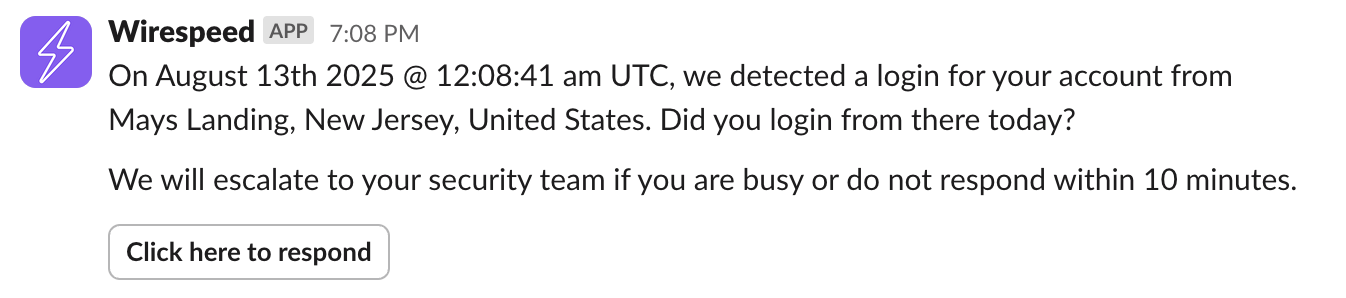
Escalations
By default, all chat ops have a delay time of 10 minutes. If the user has not responded in that window, Wirespeed continues using the rule’s configured timeout outcome. You can modify the escalation delay under Settings > Chat Ops.Security Team Notifications
Security team alerts are delivered through standard notifications and team inbox email escalations instead of a chat ops conversation. Configure:- user notification subscriptions in your profile (Notifications)
- team escalation inboxes under Settings > Team
Multi-factor Verification
After a chat ops message is sent you can optionally require the user to verify their identity over SMS. This helps protect your organization in cases where the user’s account has already been compromised. When this setting is enabled, the user will be texted an SMS code to verify their identity after they respond to our chat ops message. If no mobile phone number is identified for the user, their response cannot be verified and the detection continues using the rule’s configured timeout outcome.FAQ
What happens if a user doesn't respond to a chat ops message?
What happens if a user doesn't respond to a chat ops message?
If a user doesn’t respond within the escalation delay (default: 10 minutes), the detection proceeds with a suspicious verdict (or your configured timeout verdict).
Can I customize the escalation delay time?
Can I customize the escalation delay time?
Yes. Navigate to Settings > Chat Ops to modify the escalation delay time. Timeout outcomes are configured in the relevant verdict rule under Settings > Verdicts.
What communication channels does Wirespeed use for chat ops?
What communication channels does Wirespeed use for chat ops?
Wirespeed can send chat ops messages via Email, Slack, Microsoft Teams, and SMS. We initially message users through all available communication channels to maximize response rates.
What if the user's account is already compromised?
What if the user's account is already compromised?
If SMS MFA verification is enabled, users must verify their identity with a code sent to their phone after responding to a chat ops message. This helps ensure a compromised account cannot falsely claim activity is legitimate. If no phone number is available, the unverified response is discarded and the detection proceeds with your configured timeout verdict.